English▾


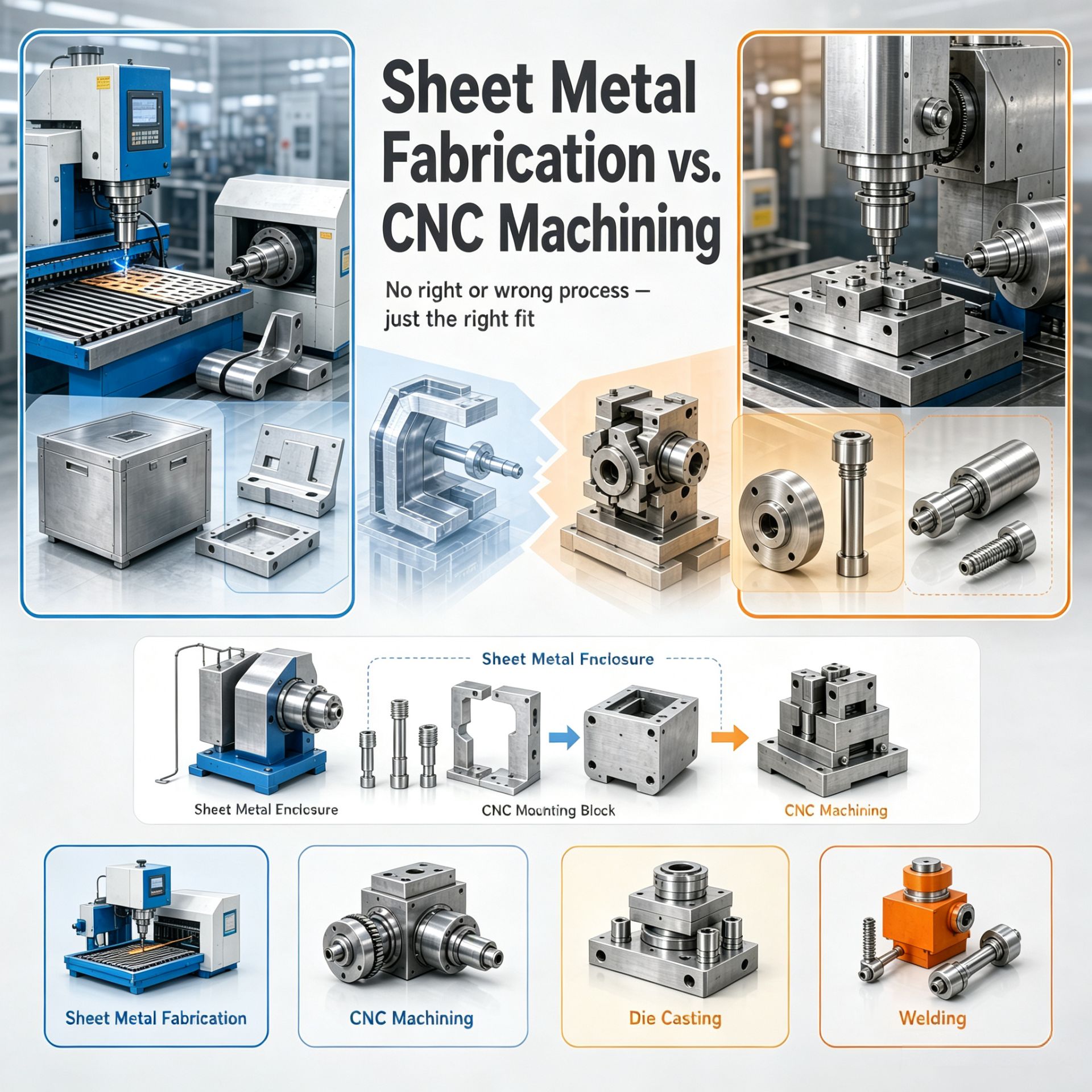
Should this part be fabricated from sheet metal, or should it be CNC machined?
There is no universal answer.
The right manufacturing process depends on the part's geometry, material, dimensional requirements, production volume, application, and target cost.
Choosing the wrong process can increase machining time, material waste, tooling costs, and lead time. In some cases, a small change to the design or manufacturing method can make a significant difference to the overall project cost.
For companies developing equipment, enclosures, brackets, panels, machinery components, and other custom metal parts, understanding the difference between sheet metal fabrication and CNC machining can make supplier communication much easier.
At Dongguan Rongzhou Precision Hardware Products Co., Ltd., we work with both processes, along with metal stamping, die casting, and welding. This allows us to evaluate a part based on its actual requirements rather than automatically recommending one manufacturing method.
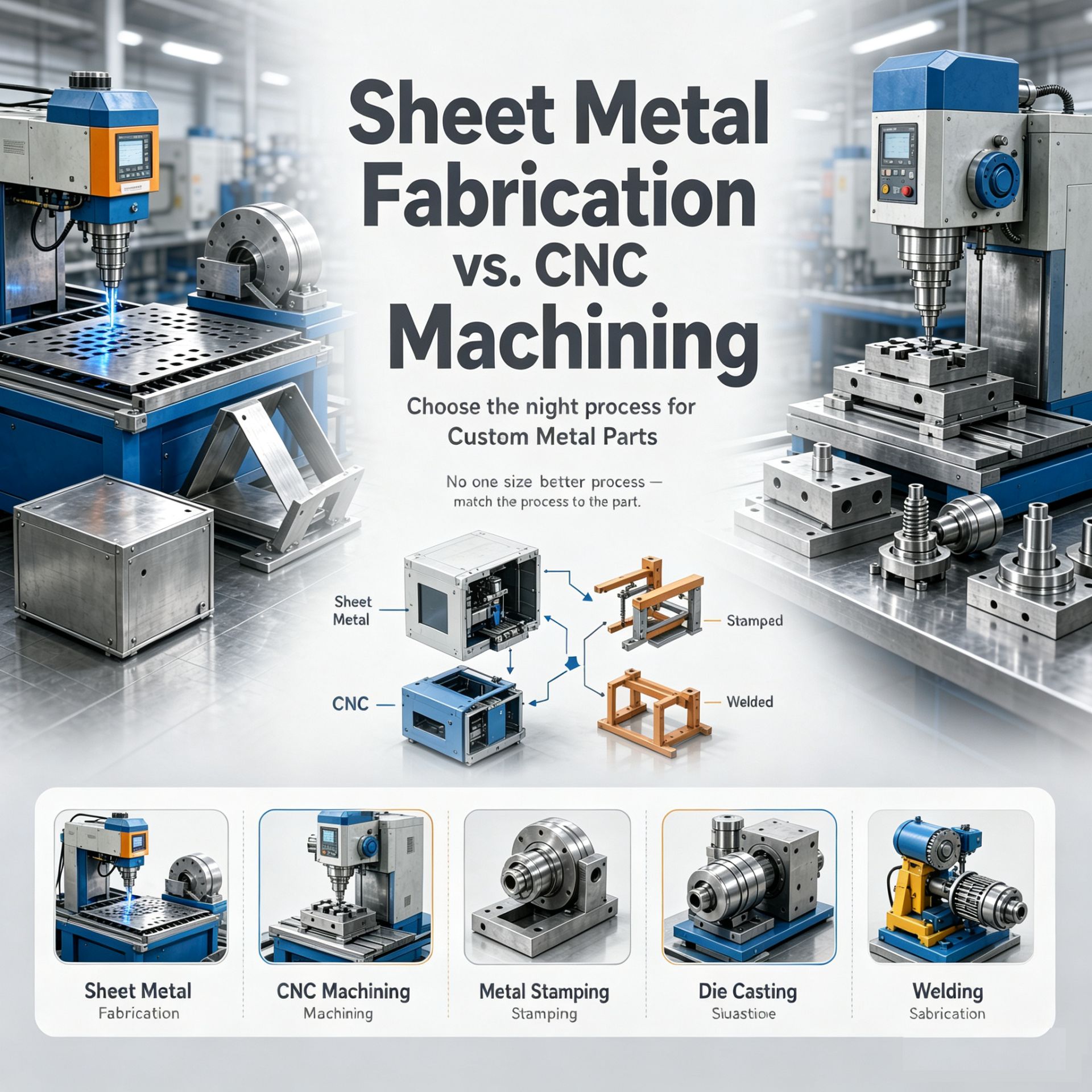
Sheet metal fabrication starts with metal sheets or plates.
Depending on the part design, the process may involve cutting, bending, punching, forming, welding, and other secondary operations.
Common materials include:
Stainless steel
Carbon steel
Aluminum
Galvanized steel
Other sheet and plate materials
Typical sheet metal products include:
Equipment enclosures
Metal cabinets
Mounting brackets
Control panels
Electronic housings
Covers
Frames
Structural components
Shielding covers
One of the biggest advantages of sheet metal fabrication is that it can produce relatively large and lightweight structures without machining the entire component from a solid block of material.
For many enclosures and structural parts, this makes sheet metal a practical and economical solution.
CNC machining removes material from a metal workpiece using computer-controlled cutting tools.
Depending on the equipment and design, CNC machining can include milling, turning, drilling, tapping, boring, and other precision operations.
CNC machining is particularly useful when a component requires:
Tight dimensional tolerances
Complex three-dimensional geometry
Precision holes and threads
Machined surfaces
Detailed pockets or slots
High repeatability
Common CNC machined products include:
Precision mechanical components
Shafts
Mounting blocks
Housings
Connectors
Fixtures
Machinery components
Custom brackets
Prototype parts
Unlike sheet metal fabrication, CNC machining often starts with a solid block, bar, or other metal stock and removes material until the required geometry is achieved.
This makes CNC machining highly flexible, but the amount of material removed can also have a major impact on cost.
The simplest way to understand the difference is:
Sheet metal fabrication forms metal. CNC machining removes metal.
But the decision is more complicated than that.
The following factors usually matter most.
| Factor | Sheet Metal Fabrication | CNC Machining |
|---|---|---|
| Basic process | Cutting, bending, forming, welding | Material removal |
| Typical starting material | Sheet or plate | Block, bar, or billet |
| Large structures | Excellent | Usually less economical |
| Thin-wall structures | Excellent | Possible but often costly |
| Complex 3D geometry | Limited | Excellent |
| Tight tolerances | Moderate to high depending on process | Excellent |
| Material efficiency | Often good for formed parts | Depends heavily on geometry |
| Prototyping | Very suitable | Very suitable |
| High-volume production | Suitable with automation/tooling | Suitable depending on part |
| Enclosures | Excellent | Usually unnecessary for large housings |
| Precision mechanical parts | Limited by geometry | Excellent |
The key is not to ask which process is “better.”
The better question is:
Which process is better suited to this particular part?
Sheet metal is often the better choice when the component is primarily a flat or bent structure.
For equipment housings, cabinets, electrical enclosures, and machine covers, sheet metal is usually much more practical than machining the entire enclosure from a solid block.
Many brackets can be produced efficiently through cutting and bending.
The design can often be optimized around the bending process, reducing unnecessary material removal.
Control panels, access panels, protective covers, and shielding components are natural applications for sheet metal fabrication.
When the objective is to create a relatively large structure without excessive weight, sheet metal can offer a good balance between strength, weight, and manufacturing cost.
Modern sheet metal equipment allows manufacturers to produce prototypes and smaller batches without requiring the same level of dedicated tooling associated with some traditional forming processes.
CNC machining becomes more attractive when precision and geometry become the dominant requirements.
If a component requires precise dimensional control, CNC machining may be more appropriate.
The exact achievable tolerance depends on material, geometry, machine capability, tooling, and inspection requirements, so tolerances should always be discussed with the manufacturer before production.
A component with multiple curved surfaces, pockets, steps, contours, or intersecting features may be difficult or inefficient to produce from sheet metal.
CNC machining can provide much greater geometric freedom.
Components requiring multiple precision holes, threaded features, bores, or accurately positioned mounting surfaces are often well suited to CNC machining.
If the part needs to interface precisely with bearings, shafts, fasteners, electronic components, or other mechanical parts, CNC machining can provide the required dimensional control.
CNC machining is also widely used for functional prototypes because it can produce parts directly from digital CAD data without creating dedicated stamping dies.
One of the biggest mistakes when comparing sheet metal fabrication and CNC machining is assuming that one process is always cheaper.
It isn't.
The cost depends heavily on the design.
For example, imagine a large electronic equipment enclosure.
Machining it from a solid aluminum block would require removing a substantial amount of material.
A sheet metal design may achieve the same basic function using a combination of cut panels, bends, fasteners, and welding.
In this case, sheet metal is likely to be the more practical approach.
Now consider a small aluminum component with several precision holes, pockets, threaded features, and complex surfaces.
Trying to manufacture it from sheet metal could require multiple forming and secondary operations.
CNC machining may be more efficient.
The important factors include:
Material cost
Material utilization
Machine time
Tooling requirements
Number of operations
Labor
Surface finishing
Inspection
Production volume
Assembly requirements
This is why a good quotation should be based on the actual manufacturing route rather than simply the size or weight of the part.
Production quantity is another important factor.
A process that makes sense for 20 pieces may not be the best option for 20,000 pieces.
For example, metal stamping may become increasingly attractive when production volumes are high enough to justify tooling.
CNC machining can be highly flexible for prototypes and low-to-medium volume precision parts.
Sheet metal fabrication can work across a broad range of volumes, particularly when cutting and bending processes are highly automated.
This means that the ideal manufacturing process can change as a product moves through its lifecycle:
Prototype → Small Batch → Production → High Volume
A component may begin as a CNC machined prototype and later be redesigned for stamping.
A sheet metal prototype may eventually require tooling for higher-volume production.
The manufacturing process should therefore be reviewed together with the expected production volume.
Sometimes the best way to reduce manufacturing cost is not to change suppliers.
It is to change the design.
This is the basic idea behind Design for Manufacturing (DFM).
For sheet metal parts, engineers may review:
Bend radius
Material thickness
Hole-to-edge distance
Bend sequence
Corner design
Forming requirements
Material utilization
Fastener placement
For CNC machined parts, engineers may consider:
Tool accessibility
Pocket depth
Internal corner radius
Workholding
Number of setups
Material removal
Machining sequence
Tolerance requirements
A small design adjustment can sometimes reduce machining time or eliminate an unnecessary operation.
This is why it is valuable to involve the manufacturer early rather than waiting until after the design has been finalized.
This is actually very common.
A piece of equipment may use a sheet metal enclosure together with precision CNC components.
For example:
Sheet Metal Enclosure + CNC Mounting Blocks + Stamped Brackets + Welded Frame
In this situation, there is no reason to force the entire product into one manufacturing process.
Each component can be produced using the process that best fits its function.
This approach can provide a better balance between:
Cost
Precision
Strength
Weight
Lead time
Production volume
For complex equipment projects, the ability to coordinate several manufacturing processes can also simplify supplier management.
At Dongguan Rongzhou Precision Hardware Products Co., Ltd., we provide several core metal manufacturing processes under one manufacturing system:
Sheet Metal Fabrication | CNC Precision Machining | Metal Stamping | Die Casting | Welding
Our customers can provide drawings, CAD files, or samples for evaluation.
Rather than treating every drawing as a standard CNC job or a standard sheet metal job, our engineering team can review the part and consider the most appropriate manufacturing method based on the project's requirements.
For example:
A large equipment housing may be better suited to sheet metal fabrication.
A precision mounting component may be better suited to CNC machining.
A high-volume small bracket may be better suited to stamping.
A complex metal housing may benefit from die casting.
A structural assembly may require welding.
And in many projects, several of these processes may be used together.
This is the advantage of having multiple manufacturing capabilities available through one supplier.
With 16 years of precision hardware manufacturing experience, Rongzhou supports customized metal components for international B2B customers.
Our capabilities cover both prototype and production requirements, from smaller customized orders to larger production runs depending on the product and process.
Typical applications include:
Machine enclosures
Equipment housings
Sheet metal brackets
Metal panels
Shielding covers
Structural components
CNC precision parts
Custom hardware components
Welded assemblies
Quality control is carried out through multiple inspection stages, with dimensional inspection and documentation available according to project requirements.
For overseas customers, our service also covers drawing communication, production coordination, packaging, and export order support.
The goal is not simply to manufacture according to a drawing.
It is to make sure the selected manufacturing process is practical for the customer's actual application.
If you are unsure whether your part should be fabricated from sheet metal or CNC machined, start with these questions:
If yes, sheet metal fabrication may be a strong candidate.
If yes, CNC machining may be more appropriate.
Sheet metal is often more economical for large enclosures and structures.
CNC machining may be better suited, depending on the specific tolerance requirements.
Consider whether stamping, die casting, or other production methods may become more economical.
An integrated supplier with multiple manufacturing processes may simplify the project.
Most importantly, don't choose a process based on one factor alone.
Part geometry + material + tolerance + volume + application + target cost should be considered together.
There is no single “best” manufacturing process for every custom metal component.
Sheet metal fabrication is highly effective for enclosures, brackets, panels, covers, and larger structures.
CNC machining is a strong choice for precision components, complex geometries, tight dimensional requirements, and functional prototypes.
Metal stamping and die casting can become attractive for specific designs and higher production volumes.
Welding remains essential when several metal components need to become one structural assembly.
The real value of a manufacturing partner is therefore not simply having different machines.
It is knowing which process to use, when to use it, and how different processes can work together.
With 16 years of experience across sheet metal fabrication, CNC precision machining, metal stamping, die casting, and welding, Dongguan Rongzhou Precision Hardware Products Co., Ltd. helps international customers evaluate and manufacture customized metal components according to their drawings, samples, and project requirements.
If you have a drawing and are unsure which manufacturing process is right for your part, send it to our engineering team for a manufacturing evaluation and quotation.